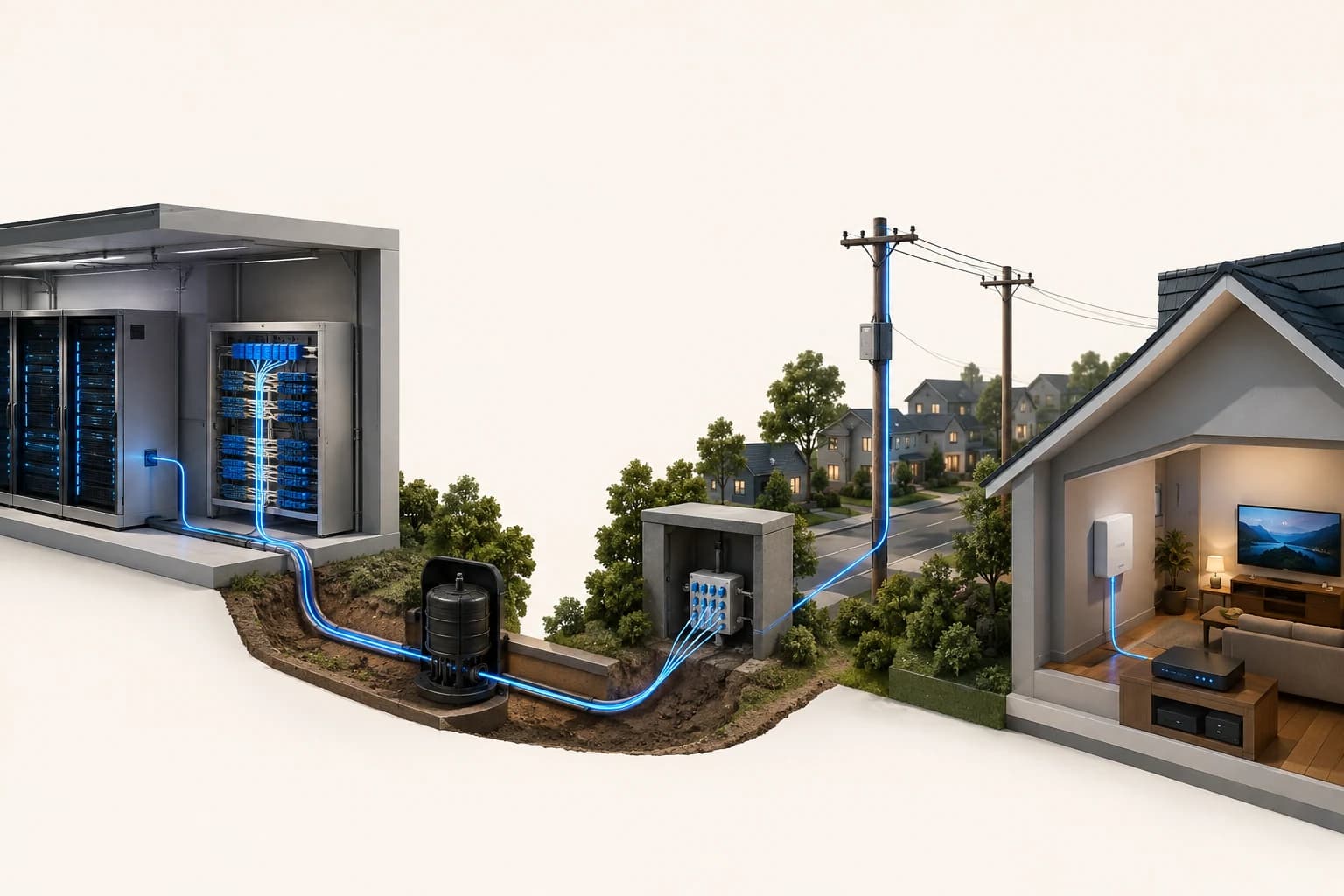
Where Does the Fiber Start, and Where Does It End?
The first wall a new field engineer hits is not the equipment. It is the vocabulary. OLT, ONU, ONT, FDF, splitter, closure, central office. The drawings use these words with no explanation, and the senior engineer says "that's just what we call it" and moves on.
Here is the thing, though: every one of those words is a point sitting in order along a single path. Get the order straight and you are halfway there.
The Order the Signal Travels
From the central office to a working internet connection in someone's living room, the optical signal passes roughly through this chain:
Central Office → OLT → Fiber Distribution Frame (FDF) → Feeder Cable → Splitter → Distribution Cable → Drop Cable → ONU/ONT → Subscriber Equipment
Let's walk through what each point does.
OLT — The Transmitting End
The OLT (Optical Line Terminal) sits in the operator's central office. It connects upstream to the backbone network and pushes optical signals downstream toward subscribers. A single OLT chassis holds multiple line cards, and each card carries multiple PON ports.
The key fact is this: one PON port serves many subscribers. Exactly how many is decided by the splitter ratio we'll cover shortly.
FDF — Where Cables Get Organized
The FDF (Fiber Distribution Frame) is the patch panel inside the central office where equipment-side patch cords meet the outside plant cables.
The FDF matters in the field for a simple reason: it is the first place you check when a link goes down. A connector that is dirty, or seated slightly short, is enough to kill a link — and it happens more often than anyone expects.
Splitter — Where One Becomes Many
An optical splitter is a passive component that divides one incoming optical signal into several outputs. No power required. We name them by ratio: 1:8, 1:16, 1:32.
That "no power required" part is the economic core of FTTx. You don't have to run electricity to a mid-span point, which drops both installation and maintenance costs dramatically. The trade-off: the more ways you split, the weaker each output gets. Calculating that loss is the optical power budget, and it gets its own lesson.
ONU / ONT — The Receiving End
The subscriber-side terminating equipment. It converts the optical signal back to electrical and hands it off over Ethernet or Wi-Fi.
ONU and ONT often refer to effectively the same thing. If you want to draw the line: ONT usually means the terminal inside a subscriber's home, while ONU refers to a unit serving several subscribers from a basement or floor-level enclosure. Definitions vary between documents, so it is more reliable to judge by where the device sits in the drawing than by what the label says.
What the x in FTTx Means
FTTx stands for Fiber To The x, where x tells you how far the fiber actually goes.
- FTTH (Home) — fiber runs all the way into the subscriber's premises.
- FTTB (Building) — fiber reaches the building; existing copper carries it the rest of the way.
- FTTC (Curb) — fiber reaches a street-side cabinet; copper covers the last stretch.
The closer x gets to the subscriber, the better the speed and stability — and the higher the construction cost. In practice, which one you deploy is less a technical decision than a cost-and-building-conditions decision. Pushing FTTH into an older building with no usable conduit means climbing walls, and at that moment the job becomes something else entirely.
What to Look at First in a Drawing
Hand a drawing to a new engineer and they will start tracing lines. There are three things worth checking before that.
- How many splitter stages? One stage or two changes the loss calculation completely.
- Where are the splitters? In the central office, in a mid-span closure, or in the building basement?
- How many subscribers? How many homes hang off a single PON port?
Those three answers tell you most of what kind of network you are looking at. The detailed routing comes after.
Summary
- The signal starts at the OLT, passes through the FDF and splitters, and terminates at an ONU/ONT.
- Splitters divide the signal without power, and the price you pay is attenuation.
- The x in FTTx is how far the fiber goes, and it is usually decided by cost.
In the next lesson we look at PON and splitters — how one fiber strand actually gets shared by dozens of households without the traffic colliding.