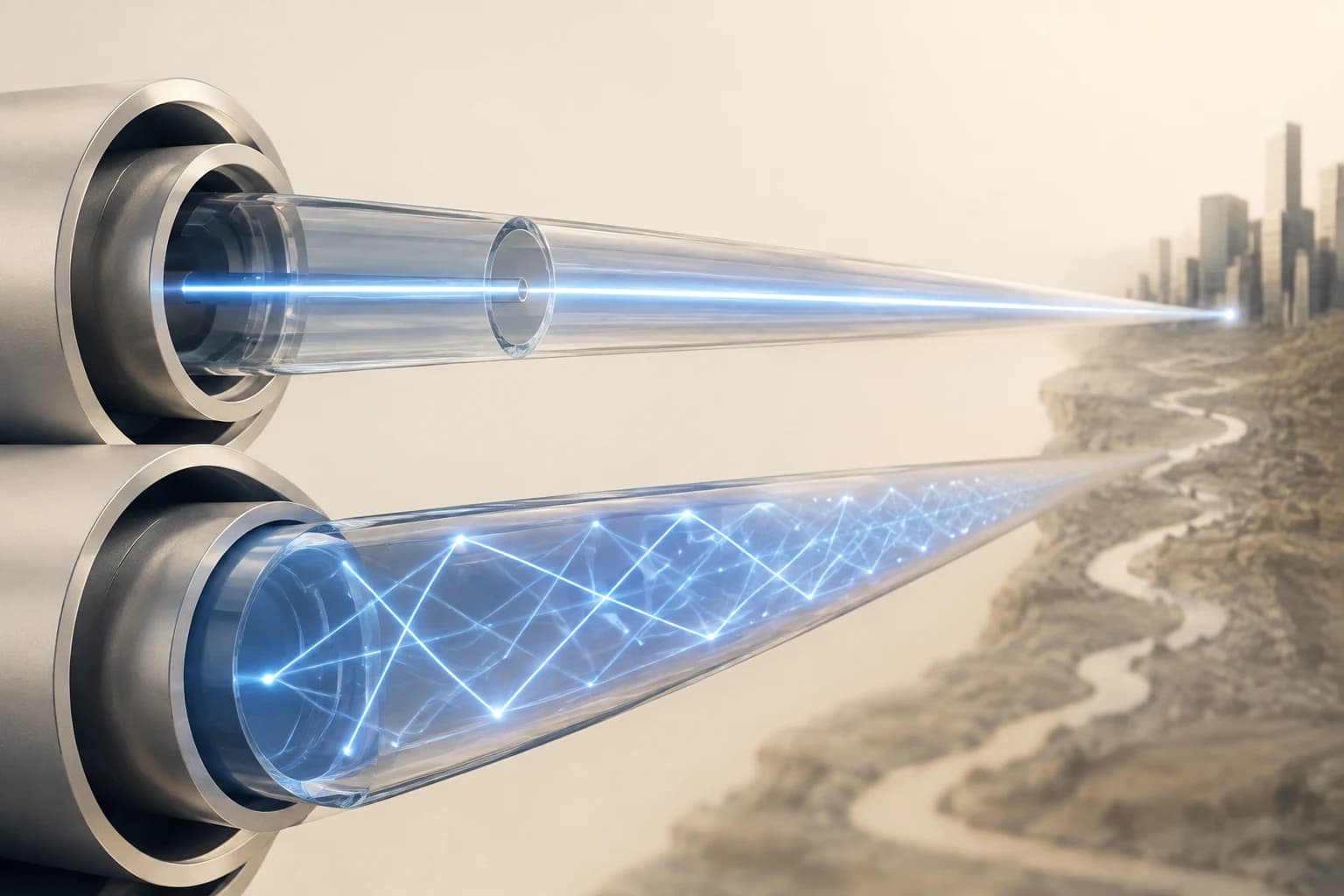
Two Fibers That Look Identical
Pull a single-mode and a multimode fiber out of their jackets and you cannot tell them apart by eye. Both are glass strands about 125 micrometres across. The difference is inside, in the core.
- Single-mode — core around 9 µm. Light travels essentially one path.
- Multimode — core around 50 or 62.5 µm. Light bounces along many paths simultaneously.
That one number decides almost everything else.
Why the Core Size Matters
In a wide multimode core, light entering at slightly different angles takes paths of different lengths. Rays that bounce more arrive later than rays that go nearly straight. A pulse launched as a sharp spike arrives at the far end smeared out.
This is modal dispersion, and it puts a hard ceiling on how far you can push data. Past a certain distance, consecutive pulses blur into each other and the receiver cannot tell them apart.
A single-mode core is narrow enough that only one path is supported. No modal dispersion, so the reach is dramatically longer — tens of kilometres instead of hundreds of metres.
So Why Does Multimode Exist at All?
Because the wide core is easier to work with, and historically the transceivers were much cheaper. Aligning light into a 50 µm target is far more forgiving than hitting 9 µm. Connector tolerances relax, and LED-based sources were adequate.
Inside a data centre or a building riser, where runs are short and connector counts are high, multimode still makes economic sense.
In access networks — FTTx — it does not. Spans are kilometres, splitters are in the path, and the wavelength plan assumes single-mode behaviour. Access plant is single-mode, full stop.
The Fiber Types You Will Actually See
Single-mode is not one thing. The ITU-T G.65x designations matter in the field.
표가 넓으면 좌우로 스크롤하여 확인하세요.
| Type | Common name | What it gives you |
|---|---|---|
| G.652.D | Standard single-mode | The default. Low water peak, works across all common bands |
| G.657.A1/A2 | Bend-insensitive | Tolerates tighter bends. Drop cables and in-building |
| G.657.B3 | Extremely bend-insensitive | Very tight radius work, riser and apartment installs |
G.657 is what makes modern in-building work practical. Ordinary G.652 loses meaningful power at the bend radii you are forced into behind a skirting board or around a doorframe. Bend-insensitive fiber holds its loss much better in the same geometry.
The important compatibility fact: G.657.A is designed to splice and interoperate with G.652.D. You can run G.657 drop cable off a G.652 distribution network without a mismatch penalty worth worrying about. G.657.B is more specialised and can show a small mismatch when joined to G.652.
Where This Goes Wrong in the Field
Mixing multimode patch cords into a single-mode link. It happens because the connectors mate perfectly. Nothing physically stops you. The link either fails outright or comes up with loss nobody can explain. The colour coding exists for this reason — yellow jacket for single-mode, orange or aqua for multimode — and it is worth enforcing even when the store room is disorganised.
Assuming all single-mode is interchangeable. Splicing dissimilar fiber types produces a small mode-field mismatch loss. Individually tiny, but on a link that is already tight on budget it is one more thing you did not account for.
Ignoring the bend spec on drop cable. Specifying bend-insensitive fiber and then still forcing it around a sharp corner does not make the loss disappear. G.657 buys margin; it does not repeal physics.
A Practical Rule
For access plant, the decision is usually already made for you: G.652.D on the feeder and distribution, G.657.A on the drop and inside the building. The engineering question is not which fiber, but whether what actually arrived on site matches what the design specified.
Check the cable print. It is written along the jacket. Two minutes there saves a day of chasing a loss reading that was never going to make sense.
Summary
- Core diameter is the real difference: 9 µm single-mode, 50/62.5 µm multimode.
- Multimode suffers modal dispersion, which caps distance. Access networks are single-mode.
- G.652.D is the default; G.657 bend-insensitive fiber is what makes in-building work practical.
- G.657.A interoperates with G.652.D. Mixing multimode into a single-mode link is a classic and avoidable failure.
- Read the jacket print before you believe the drawing.