Everyone on the Port Is Down and the Fiber Is Fine
A whole PON port degrades or drops. The feeder measures clean. The OTDR shows nothing. Subscribers come and go seemingly at random.
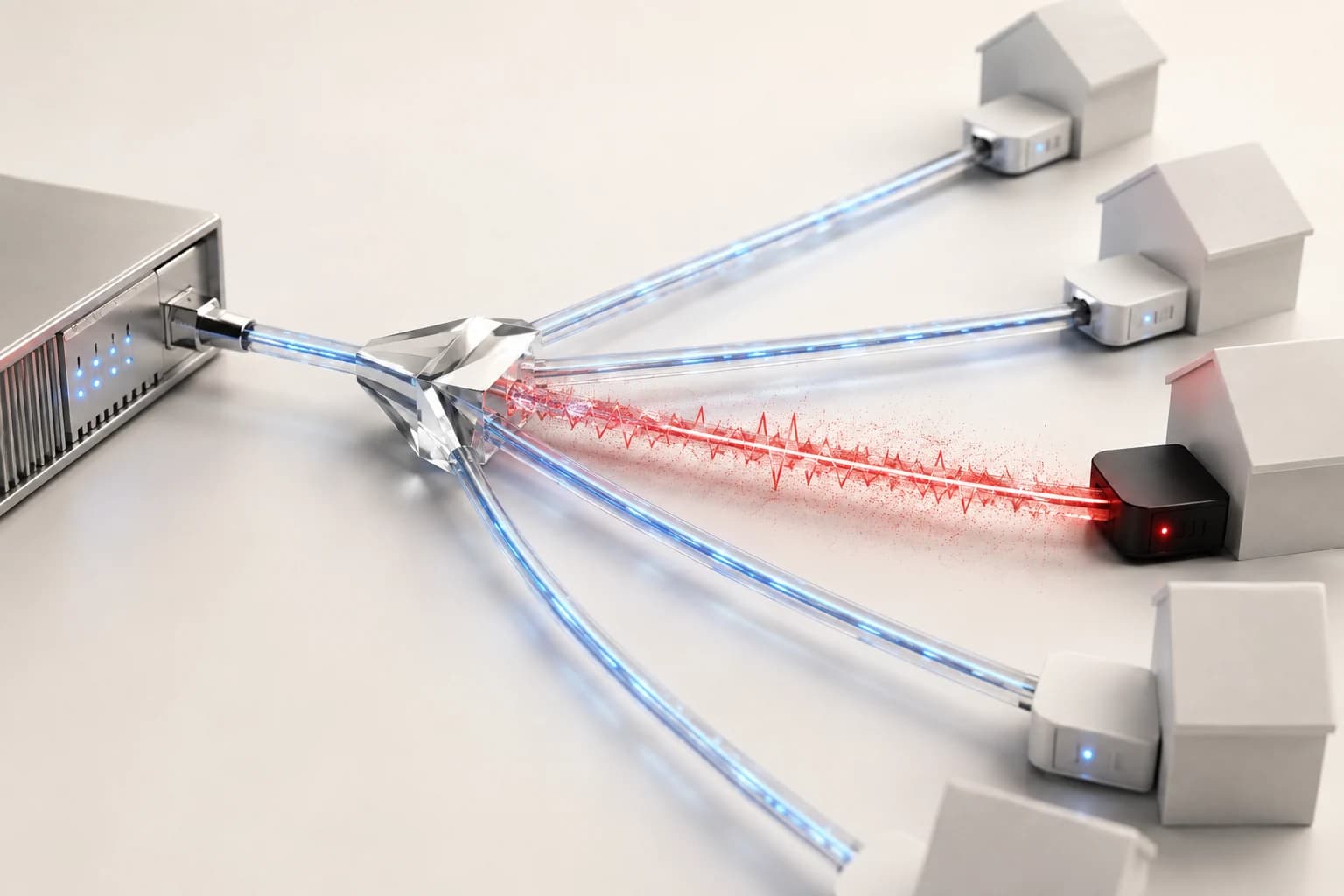
This is the signature of a rogue ONU: one subscriber unit transmitting when it should not, corrupting everyone else's upstream traffic.
It is worth understanding because it is the one fault type where the plant is healthy and the diagnosis is entirely logical rather than optical.
Why One Unit Can Do This
As covered in the PON lesson, the upstream direction is time-shared. The OLT tells each ONU exactly when to transmit, and every ONU stays silent otherwise. All those bursts travel up the same fiber and arrive at one receiver.
That arrangement has no defence against a unit that ignores its schedule. An ONU transmitting continuously, or during other units' slots, collides with every other subscriber's traffic on that port. Downstream is unaffected, because downstream is broadcast from the OLT.
Hence the characteristic symptom set:
- Downstream levels normal, downstream service partially working
- Upstream errors across many or all subscribers on one port
- Multiple ONUs dropping and re-registering
- No optical fault anywhere in the plant
- Other PON ports on the same OLT completely unaffected
That last point is important. A fault confined to exactly one PON port, with clean fiber, points strongly at something on that tree rather than at the OLT or the feeder.
How to Recognise It Quickly
Look at the OLT statistics for the affected port:
Many ONUs with upstream errors simultaneously. A physical fault usually degrades a subset — those beyond the damage. A rogue affects everyone indiscriminately.
Repeated deregistration and re-registration across multiple units.
Upstream received power elevated or present outside expected windows. Some OLTs report this directly; it is the clearest single indicator.
No corresponding downstream degradation. Physical faults hit both directions. A rogue transmitter does not.
Finding the Culprit
Modern OLTs increasingly include rogue ONU detection that isolates and disables the offending unit automatically. Check whether the platform supports it before doing anything manual — it turns hours into minutes.
Without that, the method is elimination:
Disable ONUs administratively in groups. Disable half the units on the port. If the problem clears, the rogue is in the disabled half. Halve again. This is a binary search and it converges quickly — 32 subscribers takes about five steps.
Or disconnect at the splitter. Physically unmate splitter output ports in groups. Faster to reason about, but it means a site visit and it puts connectors at risk of contamination, so cap what you unmate.
Prefer administrative disabling where possible. It is remote, reversible and does not touch the plant.
Once identified, replace the unit. A rogue is a hardware or firmware fault in the ONU; it does not get fixed on site.
What Makes It More Likely
Firmware faults on a specific ONU model or version. If you find one rogue, check whether other units of the same model and firmware are deployed on other ports. This is frequently a fleet issue rather than an isolated failure.
Power problems at the subscriber. Marginal power supplies can put an ONU into odd states. Worth checking before blaming the unit itself.
Damaged or aged units, particularly after lightning or surge events in the area.
Unauthorised or mismatched equipment installed by a subscriber.
Reducing the Damage in Advance
Enable rogue detection if the OLT supports it. The single most effective measure.
Keep firmware consistent and current across the ONU fleet. Mixed firmware makes fleet-wide problems harder to recognise.
Record ONU model and firmware per subscriber. When a rogue is found, this is what lets you check whether more are waiting to fail.
Cap unused splitter ports. Not a rogue defence directly, but as covered in the registration lesson, reflections from open ports complicate the ranging behaviour that this diagnosis depends on.
Summary
- The shared upstream time slot arrangement means one misbehaving ONU can disrupt an entire PON port.
- Signature: upstream errors across many subscribers, downstream normal, fiber clean, other ports unaffected.
- Check for OLT rogue detection first; it isolates automatically.
- Otherwise binary-search by disabling ONUs administratively — five steps for 32 subscribers.
- Rogues are hardware or firmware faults. Replace the unit, then check the fleet for the same model and firmware.