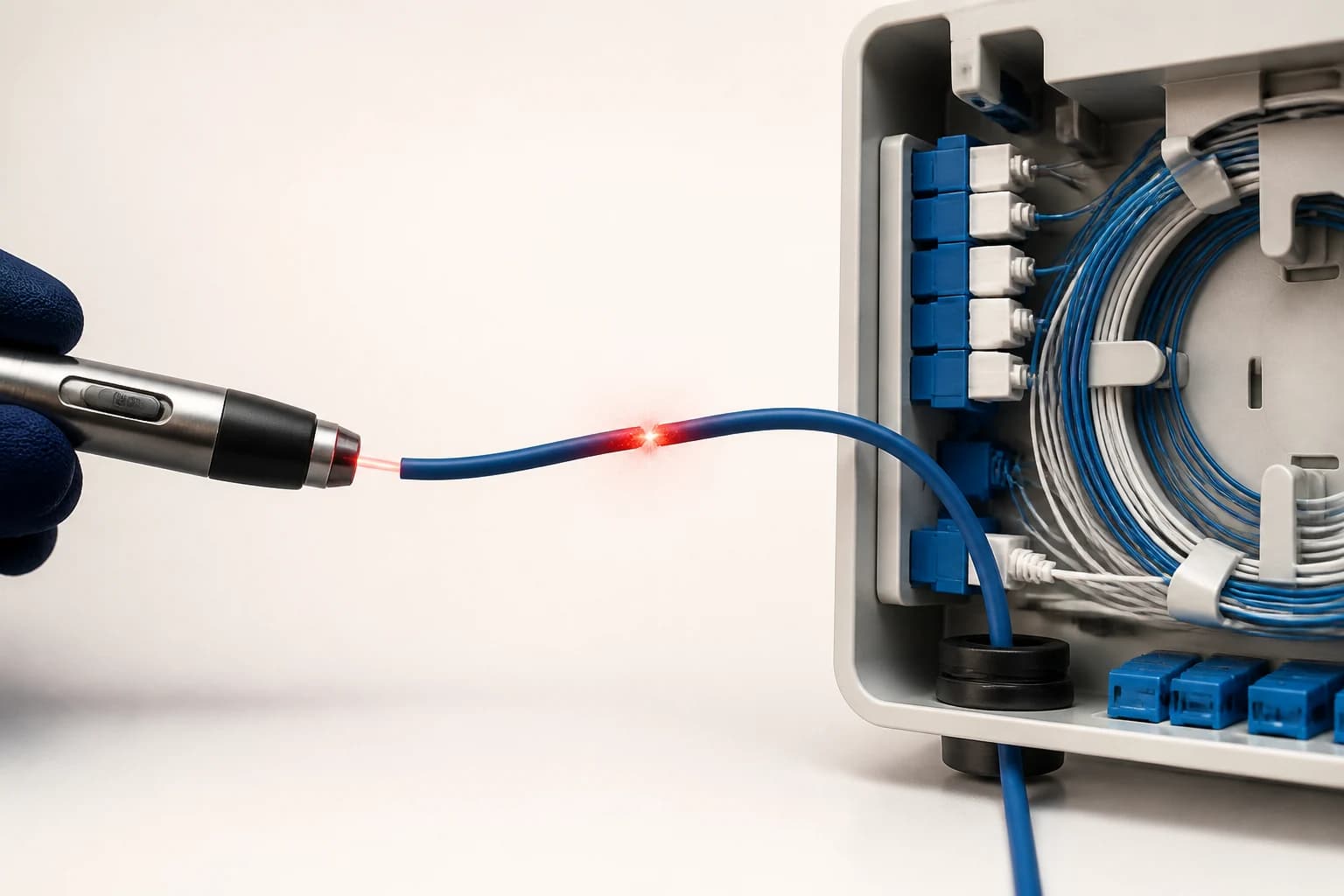
The Instrument Everyone Underestimates
A visual fault locator is a red laser, usually 650 nm, that you inject into a fiber. Where the fiber is broken or sharply bent, the light escapes and you can see it glowing through the jacket.
It costs a fraction of an OTDR and it is often the faster tool. The reason is simple: the OTDR has a dead zone and limited resolution over short distances, and a great many real faults are within a few metres of where you are standing.
What It Finds That an OTDR Struggles With
Breaks inside a patch cord. A metre-long jumper is entirely inside the OTDR's dead zone. The VFL shows the break instantly.
Faults inside an enclosure. Trays, pigtails, the coil of slack — all too close together for an OTDR to separate, and all easily visible with red light.
Tight bends causing loss. As covered in the bend radius lesson, macrobend loss is invisible. Under a VFL, a bad bend often glows.
Which fiber is which. Injecting red light at one end and looking for it at the other is the fastest way to confirm continuity and identify a strand in a bundle. This is the everyday use, not fault finding.
Bad splice protection. A splice that is not properly seated in its sleeve frequently shows a glow at the joint.
What It Cannot Do
It does not measure anything. There is no loss number. Seeing light or not seeing light is the entire output.
Range is short. Typically usable over a few kilometres at best, and much less through anything opaque. It is a local tool.
It does not see through dark jackets or conduit. A break inside a buried cable will not glow visibly through the ground. For that you still need the OTDR and the drawing.
It cannot distinguish a small loss from none. A 0.5 dB splice looks the same as a 0.05 dB splice.
So the division of labour is clear: VFL for continuity, identification, and anything within arm's reach. OTDR for distance and loss over the span.
Safety Is Not Optional Here
This is a laser, and it is aimed down a fiber that somebody may look into.
Never look directly into a fiber end. Not with a VFL connected, not without. This applies to the live network too — communications wavelengths are infrared and invisible, so there is no blink reflex and no discomfort to warn you.
Cap unused connectors — which is also the contamination discipline from the connector lesson, so there is no conflict between the two habits.
Check that the fiber is dark before injecting. Do not fire a VFL into a live network path.
Use a fiber inspection scope with a filter if you need to look at end faces. That is what it is for.
Practical Technique
Use continuous mode for tracing, flashing mode for identification. A blinking source is much easier to pick out at the far end in daylight or in a crowded panel.
Work in shade. Bright sunlight makes a marginal glow invisible. Cupping a hand over the suspect area is often enough.
Follow the fiber slowly with the jacket in view. The glow can be faint, especially through coloured buffer tubes.
On APC connectors, expect less light. The angled face couples less of the red light, and the visible output at the far end is dimmer than with UPC. Do not conclude there is a break.
Where It Fits in the Triage
In the fault sequence covered later in this course, the VFL sits early: after cleaning connectors and before rolling out the OTDR for a full trace. If the fault is in a jumper, a pigtail or the closure you are already standing next to, you will find it in under a minute, and the OTDR never comes out of the case.
Summary
- A VFL finds breaks and sharp bends within a few kilometres by making them visible.
- It excels exactly where the OTDR is weak: patch cords, pigtails, inside enclosures.
- It measures nothing. Continuity and identification are its real everyday value.
- Never look into a fiber end. Communications light is invisible and gives no warning.
- Expect dimmer output through APC connectors — that is not a fault.