We usually feel ourselves to be one continuous being. Even when yesterday’s self and today’s self argue and waver, the belief that they are ultimately the same person does not easily collapse. Digital environments are gradually changing that familiar sense. Calendars fill gaps in memory, recommendation systems subtly bring forward our next choices of taste, notes apps preserve drafts of thought, and AI assistants help form sentences and intermediate decisions. As a result, we no longer maintain ourselves solely from within. External systems continually revise and supplement habits and judgments, making identity look less like one original than a collection of repeatedly updated versions.
This cannot be fully explained simply as increasing dependence on technology. What matters is that tools remain outside us while increasingly performing internal functions. When core abilities—memory, choice, focus, and expression—begin to be co-managed with external interfaces, we may improve but also become more unfamiliar to ourselves. The issue is not whether technology changes me, but how quietly and repeatedly that history accumulates until it feels like me itself.
1. Identity is becoming closer to a history than an essence
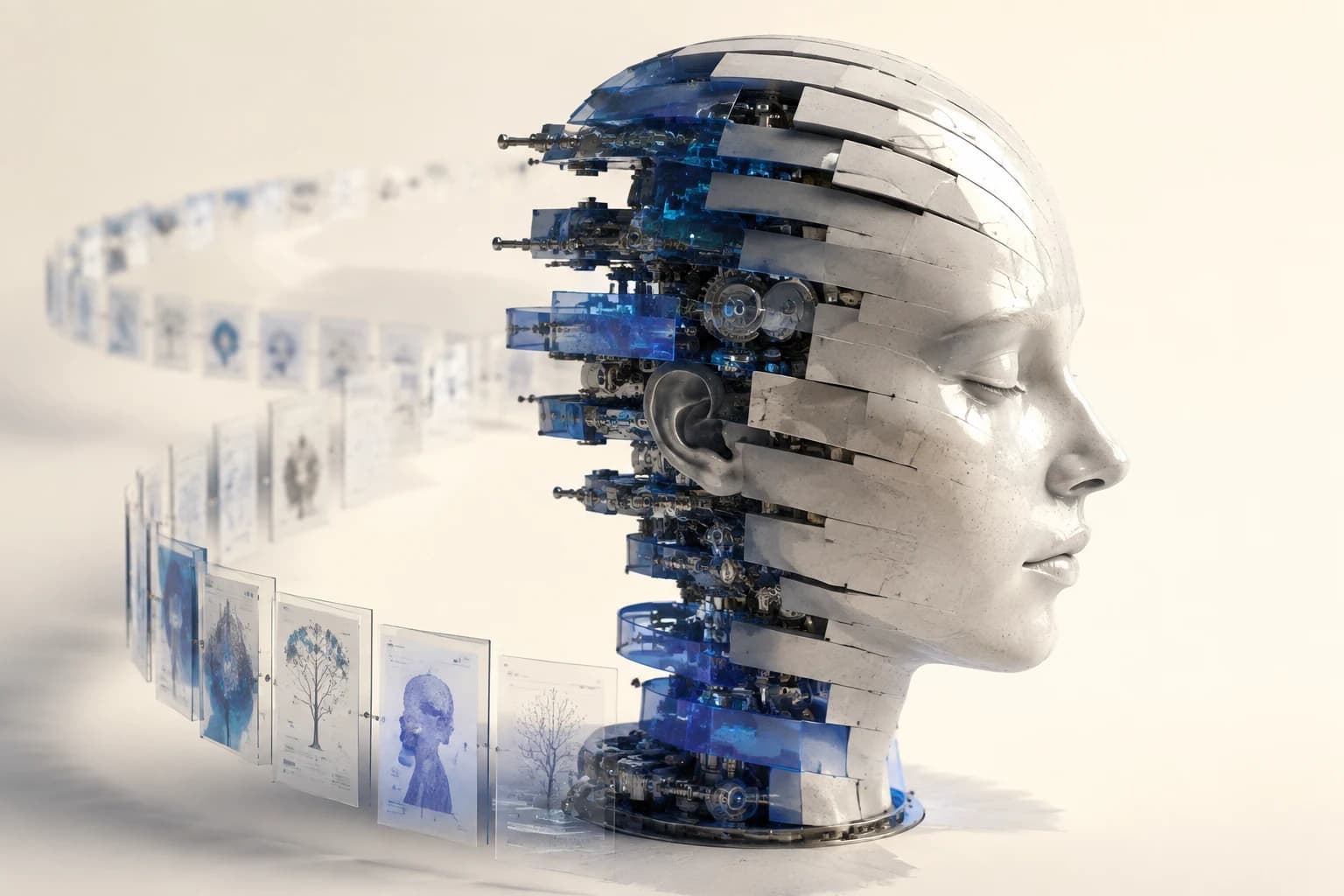
 Layers of the self accumulating like an update logView original
We once tended to describe identity in relatively stable terms such as personality, values, and taste. Humans always changed, of course, but change was often summarized as inner growth or environmental influence. Today’s changes are much finer and more frequent. We receive platform suggestions many times daily, follow already-organized options, and inhabit services that show our own forgotten behavior patterns before we recall them. Change does not originate only in our resolutions. Structures and flows presented first on a screen gently push the next action forward.
Interestingly, these changes do not feel coercive. Most systems do not command; they offer convenience. They prevent schedule conflicts, group unread mail, guide the next purchase from earlier buying history, and complete sentences we were about to write. Users receive this as help, and often it truly is. But the longer the assistance continues, the less people trace how their choices formed. As choosing becomes easier, the formation of choice becomes transparent—not more visible, but so natural that it disappears into the background.
Modern identity is therefore closer to an accumulated revision history than a sum of personality traits. Today’s self results not only from self-made decisions, but from last week’s saved template, frequently used prompts, subscribed newsletters, platform-recommended routes, rhythms created by recurring reminders, and AI-organized drafts. In some ways this makes humans more complex rather than weaker. The way we read that complexity must change. Understanding a person now means observing not only their values, but the interfaces and repeating loops through which they keep updating themselves.
From this perspective, the self resembles a repository more than a statue. New commits arrive daily; earlier versions can be consulted; some changes remain as improvements and others as experiments to reverse. What matters is not change itself, but who reads the history, who approves it, and what becomes the default. Humans have always changed, but technological structures now make that change far more frequent, rapid, and recordable. The question of identity therefore changes too. “Which updates brought me here?” becomes more precise than “Who am I?”
2. AI assistance helps expression while resetting its defaults
 A structure showing how assistance systems alter the paths of expressionView original
This shift is especially clear in writing and decision-making. We no longer begin from a completely blank page. Draft titles, outlines, summaries, tone adjustments, and alternative phrasings arrive quickly; email replies and meeting notes appear partly completed. People save time and reduce cognitive burden. At the same time, the internal rhythm of forming sentences changes. Someone who once circled for a long time seeking an expression may now choose among suggested structures. The generation of thought shifts slightly from creation toward selection.
The efficiency is undeniably powerful. The problem emerges when it settles into habit. The better AI drafts become, the less consciously people notice where their own sentences begin. At some point, the sentence rhythms of an external model may already permeate what they believe is their own voice. Ways of organizing ideas, ordering arguments, placing emphasis, and even the distance between assertion and qualification begin to resemble the subtle biases of frequently used tools. This resemblance is usually not unpleasant. It is adopted easily because it is smoother and more efficient, and thus enters more deeply.
The point is not to restore a pure original self. Human expression has always formed within others’ sentences, cultures, tools, and institutions. The issue is that present assistance systems exert influence much more densely and in real time. Where books, teachers, and colleagues once changed style over long periods, interfaces used dozens of times a day now quietly reset expression’s defaults. We may be receiving not just assistance, but a new version of ourselves deployed through the very manner of assistance.
What is needed is a sense of versions, not rejection of technology. We must distinguish sentences genuinely accepted by the present self, decisions produced by autocomplete to reduce fatigue, and routines that protect us from defaults that narrow us. Without this sense, users mistake all convenience for their own will; with excessive suspicion, they interpret every form of help as loss of self. Both lose balance. The key is keeping assistance’s influence traceable even while using it. Only then can we decide whether to accept, hold, or reverse changes.
3. Future humanity may depend more on managing changes than proving an original
 A map of humanity where change management matters more than the originalView original
As more people use AI to assist memory, schedules, creation, and relationship management, our criteria for humanity may shift. We have long treated independent thought and decision as the core of autonomy. In a society where shared thinking systems are routine, doing something ourselves changes meaning. A person who handles multiple aids without losing final responsibility and direction may be judged more mature than someone calculating entirely alone. Autonomy may be redefined as coordination rather than isolation.
Three abilities matter. First, reading records: seeing which recommendations we repeatedly accepted, which assistance we trust excessively, and which routines alter our moods and judgments. Second, creating reversible structures: automation is convenient, but at least some must be switchable, revisable, or pausable to leave room for human intervention. Third, choosing explicitly: practice declaring whether to accept, revise, or reject a system’s draft. Without these three, people are not using tools so much as sliding along flows the tools created.
Seeing identity through version control does not mean mechanizing humans. Quite the opposite. People are inherently inconsistent, change with circumstances, and contain different voices at once. The version metaphor helps organize this complexity. Some changes mean growth, some accumulated fatigue, and some distortion through outside pressure. Distinguishing them requires looking at change logs alongside the current self: what was accepted or missed, where the voice began to shift, and when the criteria for judgment moved.
Future humanity may ultimately lie closer to responsibly managing a continually updated self than proving a pure original. Those who can read, choose, and revise changes will be freer than those who block all change. Technology will keep adjusting, suggesting, and supplementing us. If that cannot be avoided, one question matters: am I watching those updates too? Keeping myself is not only a matter of gripping an unchanging essence. It also means tracing, to the end, which changes are making the present self. If I am a living version under management rather than one finished product, human dignity may appear more clearly in responsible revision than in completeness.