Essay — September 2026
What Is Left Is Watching
지켜보는 일이 남는다
When automation takes over the work of the hands, the work of watching stays with people. A look at a 1983 paper and a 1948 experiment, and at how checking might be designed as real work.
It is easy to assume that once a tool does the work, the person gets some rest. The hands are free, the story goes, so what remains is judgment and creativity. Automation research has been telling a different story for decades. The work does not disappear. It changes shape, from doing the task to watching it get done.
This essay is about that change. Generative tools can now produce a first draft in seconds, and the bottleneck has moved from writing speed to reading speed. Who makes something fastest matters less than who examines it properly. I will not pretend to tell this through personal anecdotes. Instead I want to lean on a few older papers and follow, step by step, why watching is hard.
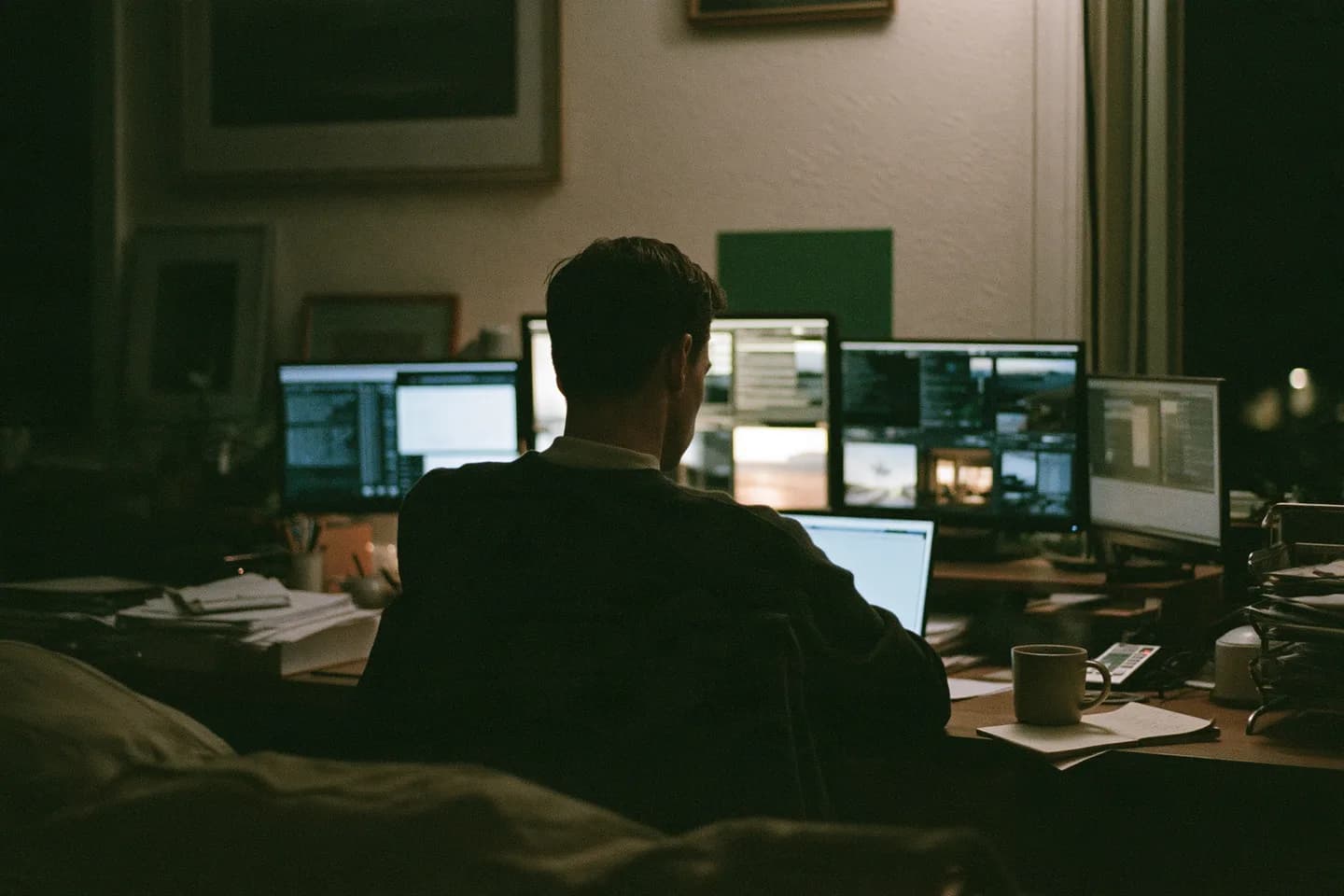
What remains where the work used to be
In 1983 Lisanne Bainbridge published a short paper in the journal Automatica called “Ironies of Automation.” Its question is plain. When an industrial process is automated, do the problems of the human operator shrink, or do they take another form? Her answer leaned toward the second. Automation can expand the human problems it was meant to remove.
The logic goes like this. Designers see the person as a source of error and try to take them out of the loop. Whatever they cannot automate is left to the person: the exception, the moment the machine stops, the fault nobody has seen before. Most of the time the machine does everything, so the operator has nothing to practice on. Then they are called in for the hardest moments only. Practice has vanished while the required skill has gone up. That structure is what the paper calls ironic.
Then there is the weight of watching itself. Staring at a screen where nothing happens, while staying ready to catch the one odd signal, is more draining than it sounds. Bainbridge concluded that as automation advances, operators need more training, not less, because the interventions are rare and decisive.
The paper was written about process-control rooms, but it maps onto today's offices with only small edits. A tool drafts the report, a tool writes the summary, a tool proposes the first version of the code. A person skims the result and signs off. The writing hand rests while the reading eye gets busier. And the reading eye tires far more easily than the writing hand.
The number thirty minutes
Why watching is so hard becomes clearer if we go back to 1948. The British psychologist Norman Mackworth built a clock task to study the vigilance of radar operators. A clock hand ticks forward one step at a time and, very occasionally, jumps two. The participant only has to notice the double jump. It is a simple task, and the participants worked hard at it.
The result was clear. After roughly half an hour, missed jumps rose noticeably. The effect became known as the vigilance decrement, and it has been confirmed and argued over for decades since. A 2025 review of its first 75 years credits Mackworth's 1948 paper as the usual starting point for the experimental analysis of the decrement. Researchers still disagree about the mechanism. The broad pattern has held: the longer people watch, the more of the rare signals they miss.
One detail in that same review is especially interesting. Mackworth found that a salient interruption, such as a telephone call, or a half-hour break could reduce or even remove the decrement. So could feedback on performance. Urging participants to be more attentive had no effect. In other words, this is not something willpower fixes. A plea to concentrate is not a design. Breaks and feedback are materials a design can use.
Bainbridge noted the same experiments in her paper, in the sense that it is very hard for even a motivated person to keep effective visual attention on a source where little happens for much longer than half an hour. One caution is needed. Thirty minutes is a figure from particular tasks and conditions. It is not a law that applies to every kind of checking. What many studies share is the direction: watching something that is mostly normal for a long time dulls the watcher without any decision to be dull.

When trust stands in for attention
The better automation works, the more another problem appears: trust begins to replace checking. In a 2010 review in Human Factors (volume 52, issue 3), Raja Parasuraman and Dietrich Manzey gave this two names, complacency and automation bias. The first is failing to monitor automation closely enough. The second is following an automated recommendation without critical review. Earlier work had treated the two separately, and the review tried to explain both through attention.
Two points from the review are worth carrying over. First, such errors are not a flaw of careless or lazy people. The authors see them as the outcome of an interaction among personal characteristics, the situation and the properties of the automated system. Second, attention sits in the middle of it. So the response has to come from designing where attention goes, not from a slogan that says be careful. The authors present their integrated model as a framework for design options in automated and decision-support systems.
Take an everyday case. Suppose a tool gives ten correct answers in a row. The eleventh answer will be doubted far less, and not because the person is foolish. Ten correct answers create a reasonable expectation about the next one. The trouble is that the expectation quietly wears down the effort of checking. The more accurate the tool, the rarer its errors, and the rarer the error, the less likely the eye is to catch it. It is the same shape as the vigilance decrement.
Designing the work of checking
So what can be done? Translating the papers into ways of working produces a few ideas. To be clear, this list is my own reading of the material above, not a prescription from the studies.
First, limit the amount. Vigilance research suggests that the longer we look, the duller the eye gets. Short, separate passes are then better than one long one. For a long document, split it into sections and write down in advance what to look for in each. The goal of reading everything carefully sounds diligent, but it tends to become a promise that erodes as the hours pass.
Second, build in gaps on purpose. Given what Mackworth found about interruptions and breaks, a pause in the middle of a review is part of accuracy, not a loss of time. Feedback belongs here too. If you can find out afterwards what you missed, the checking eye can adjust. Where a missed error disappears without a trace, review slowly turns into a formality.
Third, keep some chances to do the task by hand. Bainbridge's irony is also a statement that skill needs practice. If automation takes every repetition, people lose their feel exactly when they must step in. It can be worth doing some tasks manually. You give up a little efficiency and keep the sense that lets you say something looks wrong when it does.
Fourth, make the items to check visible. Pull out numbers, dates, proper names, quotations and links, the things that hurt if wrong, and compare them one by one. Smooth sentences make the eye slide. Broken into items, the text lets you look at the facts without leaning on its fluency. This holds whether a machine or a person wrote it.
Fifth, write down outside the tool that it can be wrong. How accurate a tool is belongs to the tool. How much a person is answerable for belongs to the organization and the individual. If it is unclear what the person pressing approve is actually confirming, everyone can end up trusting each other while nobody checks.
— The faster the tools get, the more reading speed becomes the speed of the work. —
The dignity of watching
Watching is not glamorous. Done well, nothing happens. Done badly, something large happens later. Because the result is invisible, it is easy to rate it low. When work is divided, people and time flow toward the making side, and the checking side gets the leftover minutes.
But the deeper automation goes, the more the scale tips the other way. Making gets cheaper and checking gets relatively more expensive. When the cost of making falls, more gets made, and more must be checked. I think this is why a sentence Bainbridge wrote more than forty years ago fits better today than it did then.
So respecting the work of watching is more concrete than it sounds. Give checking its own time. Plan the amount and the pauses so the person checking does not wear out. Leave a way to trace what was missed. And build into the way of working the idea that approval is not just a click but a mark of responsibility.
Automation takes the work of the hands. What stays is the work of the eyes and of judgment. Not treating that remainder as minor may be the oldest skill a person working alongside machines can have. A clock from 1948 and a paper from 1983 say roughly that much. Watching is never easy, and that is why it is worth designing.