At that harbor, fog erased the nautical charts every dawn. Instead of lighting brighter lamps to avoid getting lost, people quietly left coordinates for returning on one another’s maps.
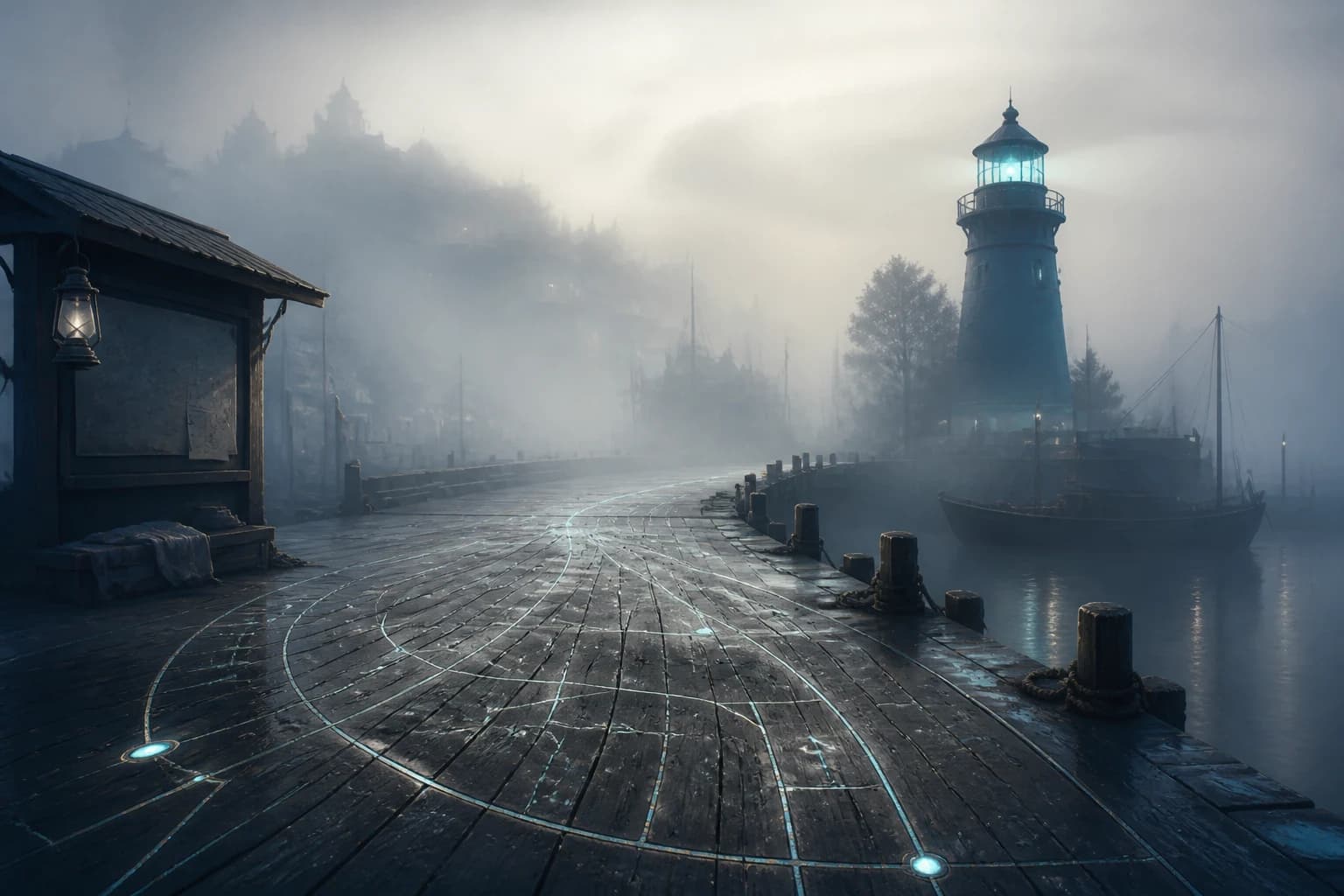
When I first entered Fog Harbor after roaming the open sea, the first thing I noticed was not the enormous lighthouse but the ground. The pier looked like old timber, but close inspection revealed layers of fine engraved lines. They were not random doodles. Passing time, lost belongings, rediscovered sentences, choices corrected after returning, and apologies understood late remained there like coordinates. The harbor keeper called the ground “the waterways of memory.” Just as boats cannot enter a blocked channel, memories cannot return on time without retrieval routes.
We learn to think of memory as strength. We believe capable people remember more, longer, and more accurately. So even when taking notes, we obsess over accumulation rather than organization, and leave records without making paths to find them again. As work piles up, notes apps thicken, screenshot folders grow heavy, and bookmarks multiply, yet nothing can be retrieved promptly when needed. We are not losing memory, but the route to it.
 A fog-covered harbor with a teal lighthouse and glowing coordinate lines engraved in the groundView original
Memory’s core is retrieval speed, not storage volume
Fog Harbor’s lighthouse did not beam all night. It flashed briefly only at designated moments. At first I did not understand: should a dangerous sea not be lit strongly and continuously? The keeper smiled. “A light left on becomes background. Only a signal at the necessary moment creates a route.”
That sentence precisely exposes our information habits. Leave notifications on all day and accept dozens of inputs indiscriminately, and the brain cannot distinguish importance. When every piece of information floats at similar brightness, nothing remains in memory. Conversely, leave key signals at infrequent intervals in a clear format and retrieval becomes dramatically more efficient.
For work notes, for example, it is better to leave only the coordinates needed for the next entry than to write a lengthy account of today. How far did you get? What should you open first next time? Where are you stuck? What is the detour? With these four things, tomorrow’s self can summon yesterday’s self again. A record overly decorated with emotion and context may feel rich while reading yet offer little help in actually restarting.
The harbor’s merchants used similar rules. They did not memorize every item in inventory. They used only three boxes: things frequently sought, things that may arrive late, and things that need immediate substitutes when absent. Simpler categories meant faster hands. Stepping back even slightly from an obsession with perfectly arranging tasks can greatly lighten our memory burden. The important task is not completing the entire map, but quickly finding the route needed now.
 A night-sea chart overlaid with navigation signals and a crystal lighthouse flashing only at short intervalsView original
Forgetting is feedback on system design, not failure
On the foggiest days, the harbor deliberately erased some markers. It initially seemed reckless: why remove signs when navigation was already difficult? But they were adjusting the environment so only important markers survived. Keeping every marker would turn the whole harbor into noise.
Our memory management is the same. Trying to remember everything looks diligent but in practice resembles a declaration that priorities have been abandoned. Forgetting does not prove incompetence. Usually it signals that the information did not reappear often enough in the current structure. It is a flaw in exposure design, rather than memory itself.
People at Fog Harbor therefore did not criticize forgotten items. They asked instead, “Where can we hang this so it appears next time?” A changed question changes the solution. Instead of enduring through mental effort, create a reappearance point: a calendar reminder, project-start template, pre-deadline checklist, or end-of-work log. The tool need not be elaborate. What matters is whether it connects to recurring entry points.
The most effective device for me was a closing line. Rather than a long diary at day’s end, I leave one line with tomorrow’s starting point: “Resume at paragraph 2 of the draft; keep the harbor metaphor for the example; simplify image descriptions.” Such a line greatly reduces next-day anxiety. It is okay not to preserve memory perfectly. With an entrance back, you can reconnect it.
Emotion must also be included in the memory system. Some days, reentry is blocked by the heart rather than the head. Logical notes alone are insufficient then. A brief sentence such as “Stopped here today because of fatigue, not lack of content” can be surprisingly powerful. Reducing self-blame speeds retrieval. What is needed in fog is not a bigger engine, but a small marker that keeps your bearings intact.
 A pier with selectively retained markers in the fog and an organized signal-flag boardView original
Lasting growth comes from reconnecting, not holding memory tighter
Boats departing the harbor did not all carry the same equipment. Some took large compasses, others slim coordinate books, others weather bottles. But all observed one rule: “Always leave one way back.” Because of that rule, they eventually gathered again even without sailing perfectly every time.
Our lives are not very different. We cannot sustain perfect concentration, complete memory, and error-free action every day. We can develop the habit of leaving a return route: record where to start, mark why you stopped, define the smallest next action, and fix the location of a context file. Such simple devices are much less affected by depleted willpower.
Memory quality is closer to the quality of life’s structure than to the performance of the brain. What comes to mind first when needed matters more than how much was put in. If something does not surface, that is a design task, not a failure. Rebuild the path. It will not be finished in one attempt. After using it for a few days, erase, shorten, and simplify it until it fits your body.
The last sign at Fog Harbor read, “Memory is not a storage box, but a technique of return.” I carried that sentence with me for a long time. Now, whenever I forget something, I try to check first whether I left a marker back instead of blaming myself. The harbor quietly proved that a life better at returning ultimately travels farther than a life that holds on to more.