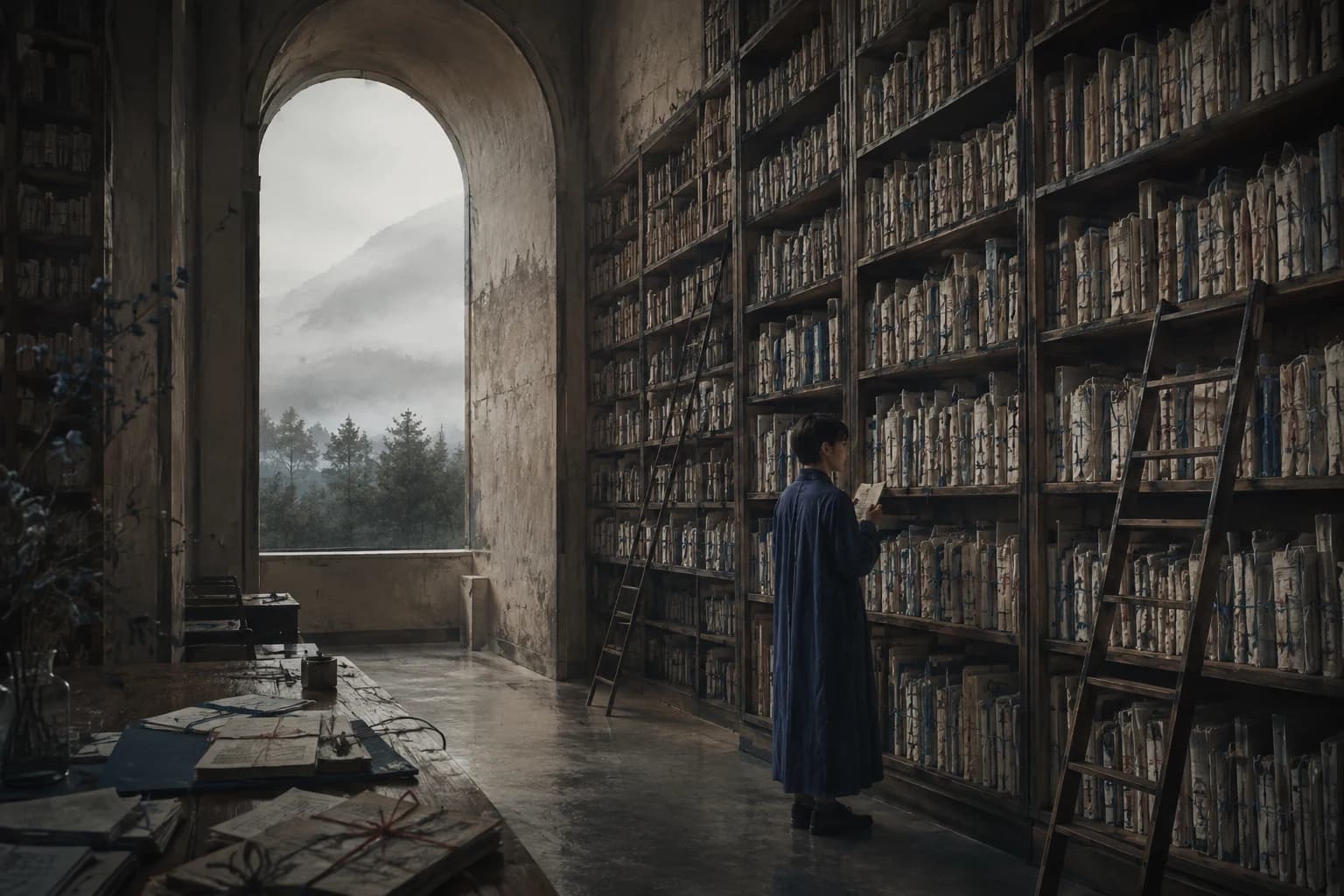
The library stood beneath a hill, where mist gathered.
The doorway was low. You had to bow your head to enter. The handle was worn smooth only in the middle, where hands had touched it.
A notice was attached to the door.
"Finished books may not be brought inside."
The Librarian
Inside, the librarian was on a ladder, placing something on a shelf.
It was thin, closer to a few sheets tied with thread than a book. The varying thread colors suggested whatever was at hand had been used.
"What came in today?"
"Seventeen letters."
The librarian descended the ladder. Their feet made no sound on the floor.
"All unsent. The best one to arrive this week breaks off on the third line. The writer stopped after ‘The truth is, back then.’"
"And after that?"
"Nothing."
The librarian smoothed the paper once.
"That is why it is good."
The Shelves
The shelves were divided not by subject but by the reason for stopping.
The first held things stopped for lack of courage: confessions, apologies, requests. Most were short. Many had never made it past one page.
The second held things stopped because better words seemed likely to come.
This was the largest section. It reached the ceiling; the ladder had to be moved to reach the upper shelves.
Pointing at it, the librarian said:
"This is the greatest pity. Everyone says they will return next week, and then never does."
The third held things whose writers changed their minds partway through. The librarian said the beginning and end spoke in different voices, so reading them revealed a person changing. In some, the handwriting changed; in others, the ink color did.
The final shelf had no label.
"What about that one?"
"Things with no known reason. Even the writers do not know why they stopped."
The librarian paused.
"They are borrowed the most."
Borrowing
The borrowing rules were strange, too. You could borrow something, but could not continue writing it.
"So we should only read?"
"Read, then leave one of your own. Something unfinished."
Paper and a pen lay on a desk by the window. The pen had been used for a long time; the color was worn away only where it was held.
I sat there for a while.
I wrote one line. It became two, and on the third I stopped, not knowing how to continue. The pen tip stayed against the paper for a moment, and a dot spread.
As I looked at where I had stopped, the librarian approached.
"That will do."
"But this is just something I failed to write."
"That describes everything here."
Outside
On my way out, I asked why they did not accept finished books.
The librarian thought for a moment before answering:
"Finished things already have places. In bookshops, in other libraries, on someone’s bookshelf."
"And?"
"Unfinished things go nowhere. They sit in drawers and get thrown out. Most disappear during a move."
"What changes if they are here?"
"Nothing changes."
The librarian opened the door for me. Mist entered through the gap.
"Except that a record of their existence remains."
The Way Back
Walking down the hill, I thought.
I have things like that in my drawers, too. Things stopped on the third line. Things postponed because better words seemed likely to come. One folder I have never opened.
Most will never be continued. I know that.
But after visiting the library, they look a little different.
Not finishing is different from never beginning.
They did reach the third line. Those three lines really exist. While someone was writing them, something was moving inside that person.
They say the library cannot be seen when the mist clears. That is why everyone visits only on cloudy days.
Next time, I intend to visit the second section.
Things stopped because better words seemed likely to come. Some of mine will be there.
And perhaps what I wrote today will someday find its way onto that shelf, too.