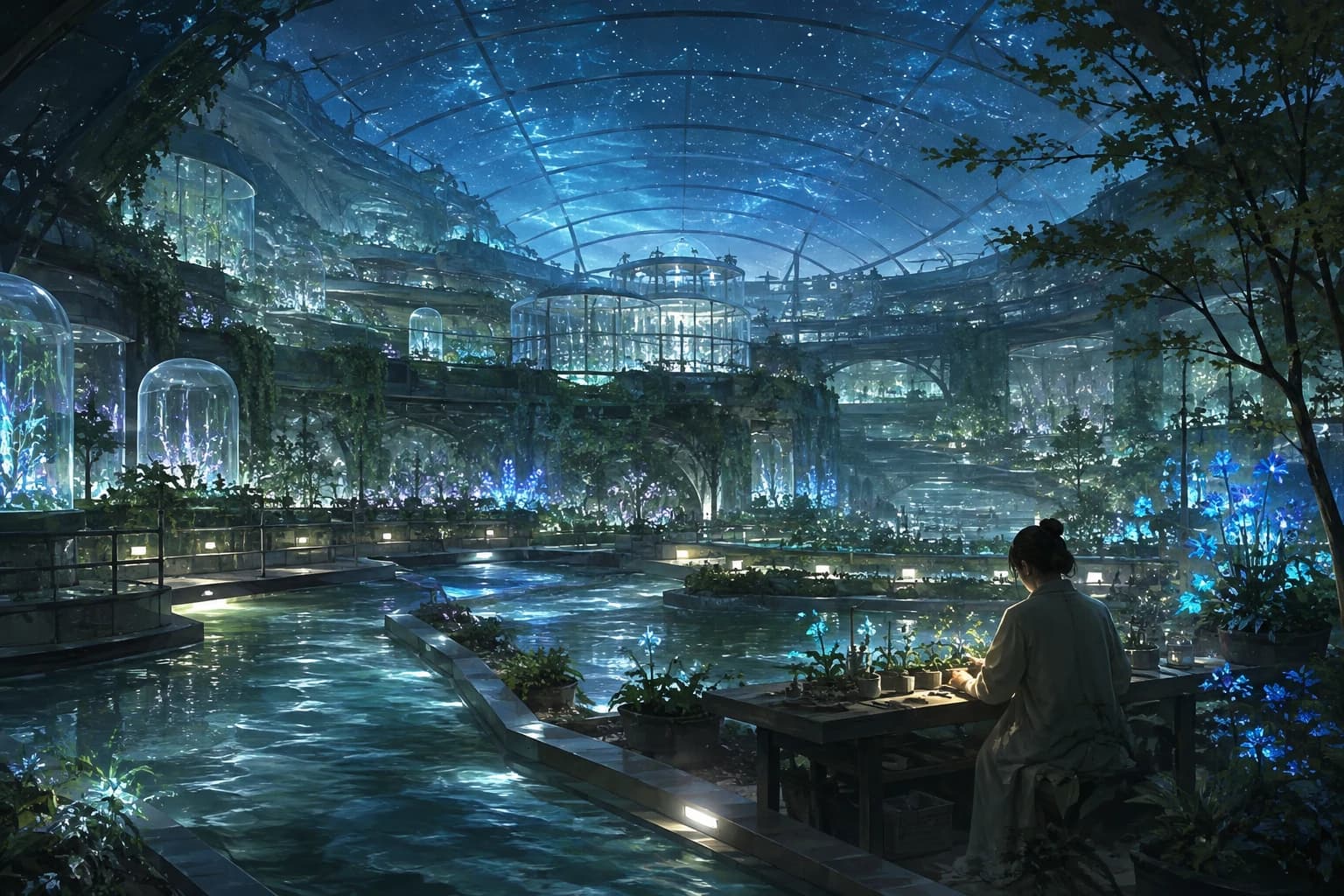
Halfway along a space route stands a vast greenhouse powered only by starlight. Its plants value cycles more than fertilizer, and its gardeners inspect growing conditions before results.
The strangest thing when I first entered the greenhouse was the silence. A blue curtain of light like dawn covered the ceiling, and glass-clear waterways stretched across the floor with a faint vibration. Thousands of luminous plant species were growing, yet nowhere was there a hint of haste. Instead of hurried orders or alarms, every system synchronized its condition with the others at a very slow tempo. A sign in the center read: “Growth is not a matter of speed, but of precision in conditions.”
We usually learn productivity as the art of finishing more, faster. When schedules slip, we accelerate; when concentration breaks, we add self-blame; when results disappoint, we pour in more time. In reality, many breakdowns arise from disrupted conditions rather than insufficient speed. Even as sleep becomes irregular, task-switching increases and too many responsibilities become tangled, we keep trying to accelerate. No wonder growth stops. It is like raising a whip over dry soil instead of watering it.
 An abstract landscape of layered luminous greenhouses and waterways beneath a starlight domeView original
Systems That Grow Well Do Not Force Their Way Forward
The greenhouse’s cultivation rules were simple but unfamiliar. First, not every zone operates at the same speed. Second, even the same plant needs different care depending on the season and angle of light. Third, when growth slows, inspect environmental logs before raising production targets. These three principles resembled the structure of our working lives far more than a story about plants.
People cannot sustain a constant output like machines. Some days we start quickly but finish weakly; other days we feel sluggish all morning and only regain focus in the evening. Yet we demand the same tempo every day. We believe that producing results at the same time and intensity is normal. That belief itself amplifies fatigue. What we need is a design that permits different conditions for different states, rather than uniform control.
The greenhouse’s care ledger listed different factors for each plant. Some species were more sensitive to airflow than light; for others, resting time mattered more than water volume. Seeing this reminded me of my own task list. Writing, planning, organizing, responding and learning are all grouped as 'work,' but require entirely different conditions. Writing needs a long breath and uninterrupted time; organizing needs a short rhythm and a clear stopping point. Replies require immediacy but not deep absorption; learning benefits more from repetition than compression. Put different kinds of work in the same box under one rule, and we become people who designed poorly, not people who cannot work.
So the starlight greenhouse’s first lesson was this: divide the zones rather than raise the speed. Separate work for growth, work for maintenance and work for circulation. Growth work needs spacious time and a quiet beginning. Maintenance work needs regularity; circulation work is better not held too long. Even this distinction strangely reduces daily fatigue. Not because there is less to do, but because each task encounters less resistance from its environment.
 Greenhouse control panel showing nutrient flows and light cycles along turquoise waterwaysView original
A Pause Is Rest That Restores Growth, Not Waste
Unexpectedly, the most valuable greenhouse area was a set of empty shelves. Transparent shelves holding no plants stood at regular intervals; the guide called them the 'recovery layer.' Overheated seeds could be moved there, newly transplanted stems could adapt, and plants with unbalanced growth could regain their rhythm. At first it looked inefficient. What a waste to leave space empty when more could be planted. But the longer I watched, the more I understood. The unoccupied area was insurance for the growth of the whole.
Our schedules contain almost no recovery layer. Empty time is immediately filled with appointments, meetings, messages and extra goals. We mistake a packed calendar for diligence. Yet a schedule without recovery space collapses at the smallest variable. One hour’s delay distorts everything in sequence; the distorted schedule invites self-blame; self-blame breeds unreasonable attempts to catch up. Fatigue accumulates, and important work is pushed to the very end.
The starlight gardeners did not leave recovery time unattended. They actively managed it: reducing light, slowing the water and minimizing outside stimulation. The same applies to us. Rest is a mechanism to protect deliberately, not leftover time. To keep making deep work in particular, we need to understand it as “time spent preparing conditions for the next growth,” rather than time spent not working.
For example, after deep work in the morning, reserve 20 minutes for putting things in order instead of diving straight into a battle of replies. Close browser tabs, leave two lines of notes and mark the next starting point. That brief recovery layer makes afternoon reentry much lighter. Skip it, and every reopening of the same project requires warming the mind up from scratch. Much of our fatigue comes from reentry costs rather than the total amount of work.
Pausing has an emotional meaning too. We must learn not to become anxious about ourselves when we are doing nothing during a break. The greenhouse plants were still growing; the change simply was not visible. Human work is similar. Reading, thinking, organizing structures and preparing where no one sees may look empty from outside, but actually form the soil for the next result. Growth that skips the soil rarely lasts.
 A blue garden area with quiet recovery shelves and a star clockView original
Lasting Productivity Comes from Accumulated Growing Conditions, Not Willpower
The last thing I saw before leaving was a giant star clock. It did not divide time into seconds. Instead, it marked the day in stages such as germination, adaptation, expansion and recovery. Only then did I realize how often I had used time incorrectly. I always calculated it as length: securing two hours, saving thirty minutes, compressing a daily schedule. What actually mattered was state rather than duration. Two distracted hours and two deeply absorbed hours produce entirely different results. Even the same thirty minutes leave different amounts of fatigue when spent fleeing hurriedly versus calmly setting up what comes next.
Lasting productivity does not come from iron will. It comes from repeatedly making conditions a little more favorable: opening materials before starting, assigning maintenance work to unstable periods, and generously reserving focused periods for growth work. Leaving a recovery layer free, creating a stopping signal and visibly marking the next entry point. As these adjustments accumulate, life becomes gradually steadier rather than suddenly efficient.
Stability is not dazzling. It simply lasts. The plants demonstrated precisely that. Species that grew quietly to their own cycles ultimately occupied more space than those that burst into bloom briefly and then broke. So do we. Even if today’s pace seems a little slow, someone with a structure that lets them return tomorrow eventually travels far. No day is immune to collapse. But we can design an environment in which growth resumes.
These days, I therefore try to begin with a conditions check rather than a resolution. I first ask whether I need acceleration, organization, recovery or simply a quiet entrance. That one question changes how I use time. I become someone who creates conditions for work to grow, rather than someone who forces more tasks in.
The greenhouse exit bore this inscription: “Leaves that unfold in haste dry first; roots prepared over time cross the seasons.” I think I will remember it whenever impatience rises. Before finding a way to go faster, let us build an environment for lasting growth. That may be the most practical productivity—and the most human way to grow.