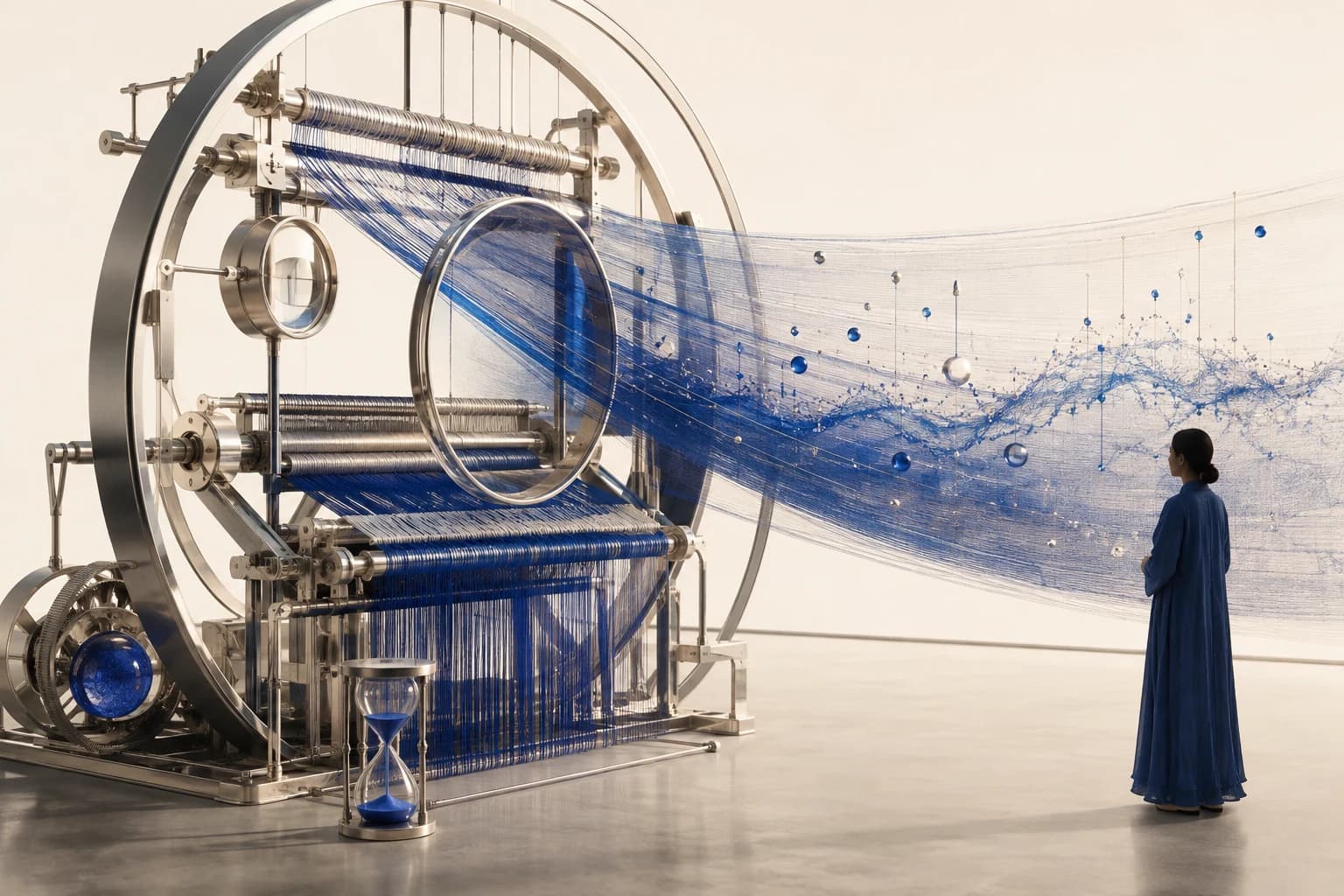
Most interactions today give the answer too quickly. Click and the view changes instantly; type and results appear immediately; users move to the next screen without a moment to hesitate. Measured solely by efficiency, it is nearly perfect. In creation and appreciation, however, that perfect speed can thin the surface. Scenes arrive quickly, but the mind loses time to arrive. The question future arts is revisiting is simple: rather than delivering results faster, how can we fill the moments just before arrival with meaning?
The point is not to increase delay, but to design the texture of feedback. If three waiting seconds vanish into emptiness, dissatisfaction remains. If those same seconds call forth anticipation and interpretation, they become part of the work. Slow feedback is not a technical compromise but a stage device that can be directed.
1. The structure of a response creates immersion more than its speed
 First scene of the loom of attentionView original
We have long measured interface value through speed. Data showing higher conversion from shorter load times and better satisfaction from faster responses remains valid. But the same formula does not apply unchanged to artistic experience and long-term memory. Feeling that something was fast and feeling that it stayed with you belong to different kinds of experience. The former is the language of processing efficiency; the latter is the language of emotional editing.
Future-arts interaction design therefore does not optimize response speed alone. It treats the order, intensity, and spacing of responses as one rhythm. Instead of showing a finished work immediately after the generate button is pressed, it might first reveal the character of the input through visual clues. Short, firm sentences briefly appear as compressed block patterns; long, fluid sentences as spreading textures. The user has not yet seen the result but begins to anticipate bodily the direction from which it will arrive.
This prediction process matters because it turns appreciation from consumption into participation. Users receiving only an immediate result easily remain recipients of a finished product. Users interpreting clues before arrival are already beginning an internal act of co-editing. Their tastes, memories, and recent moods shape how they read those clues, and the finished work arrives as comparison and reinterpretation rather than simple confirmation. Immersion therefore does not come only from fast responses. It deepens where predictable signals cross with unpredictable results.
2. Slow feedback can be a foothold for interpretation rather than an inconvenience
 Second scene of the loom of attentionView original
Designing slow feedback is often mistaken for UX that deliberately makes people wait. What is actually needed is not additional delay but information design within the interval. Users dislike not waiting itself, but receiving no meaning while waiting. Designers should change the question from “How many seconds can we remove?” to “What sensations can fill these same seconds?”
Practical patterns are fairly clear. First, do not end status feedback with one descriptive sentence. Instead of merely saying generation is underway, use nonverbal signals suggesting the result’s character: changes in color temperature, layer density, or converging noise. Second, design feedback as a sequence rather than a single frame. Different tensions at 0.4 seconds after the start, 1.8 seconds midway, and 3.0 seconds just before completion can shorten perceived time while increasing meaning. Third, give completion an arrival that logically connects to the preceding interval, rather than an exaggerated explosion. The user should feel connection, not deception.
This approach is powerful in education too. Briefly visualizing a learner’s reasoning traces rather than immediately displaying the answer clarifies understanding. In creative tools it is even more evident. Tools that make intermediate states interpretable bring users back more than tools that merely throw finished results at them, because users can read how their choices affected the outcome. Slow feedback is therefore not the opposite of speed. In learning and creation, it is closer to a device for restoring a sense of control and the right to interpret.
3. The next advantage combines output quality with the staging of arrival
 Third scene of the loom of attentionView original
Generative quality continues to rise and converge. Eventually, most tools will produce good-enough results quickly enough. At that point, differences will open up in how experiences are composed rather than in output itself. Given the same quality, some systems are used once and forgotten, while others are chosen for the next task. What creates the latter is not a feature list, but the design of arrival.
An operational checklist is needed here. First, separate user-behavior data by feedback stage. Instant-response systems always look better if you examine only clicks and completions; tracking retry, saving, and sharing rates after a session often reveals slow-feedback designs winning on long-term metrics. Second, connect delay to trust metrics instead of treating it only aesthetically. Understandable clues about what is being processed, rather than just progress, reduce abandonment. Third, let users adjust staging intensity. Offering both immersive and fast modes preserves experience quality and work efficiency together.
Ethics matter. Slow feedback is a powerful tool of emotional staging and can easily become exaggerated. Holding users with flashy animations unrelated to processing, or packaging a simple result as a grand arrival, can lengthen short-term visits while sharply reducing trust. Good design does not romanticize waiting. It honestly shows the structure of necessary time and offers interpretable clues within it. With that balance, users see the system as a stage they can work with, rather than an impressive toy.
The next round of future arts is therefore not an extension of the speed race. Those who design response structure, edit the moment of arrival, and return interpretive space to users will last longer. Technology is already becoming fast enough. One question remains: what rhythm will we place atop that speed? That rhythm becomes the brand’s tone, the work’s grammar, and ultimately the reason users return.