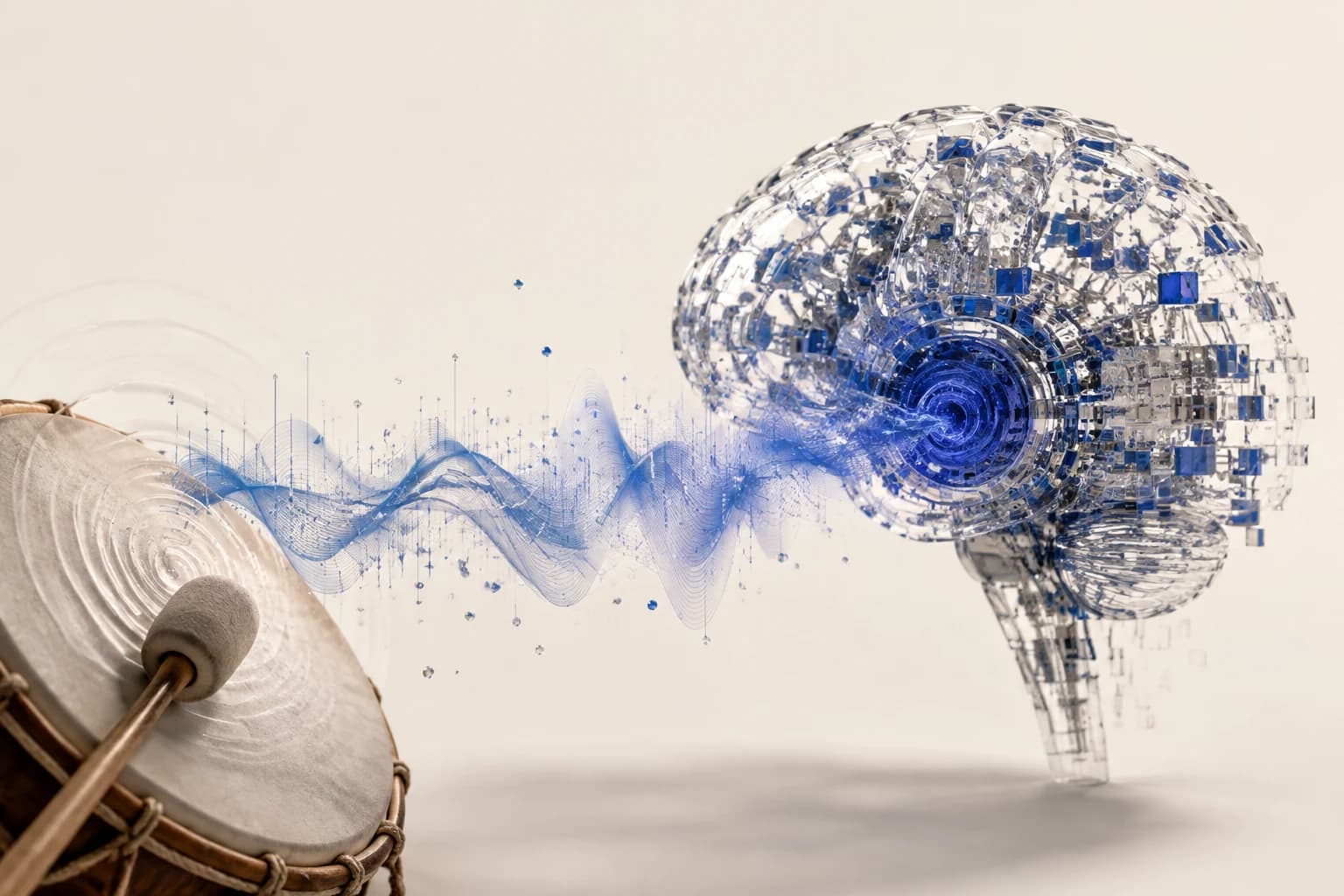
Sound is invisible, yet Vibration exists. The primal resonance early humans felt beating drums in caves is now reborn as a mathematical Waveform on silicon chips. AI does not hear sound. It merely computes frequency data. Generative Audio blossoming from that cold calculation poses a fundamental question: is Inspiration a mysterious product of the human brain, or a probabilistic combination of vast amounts of data?
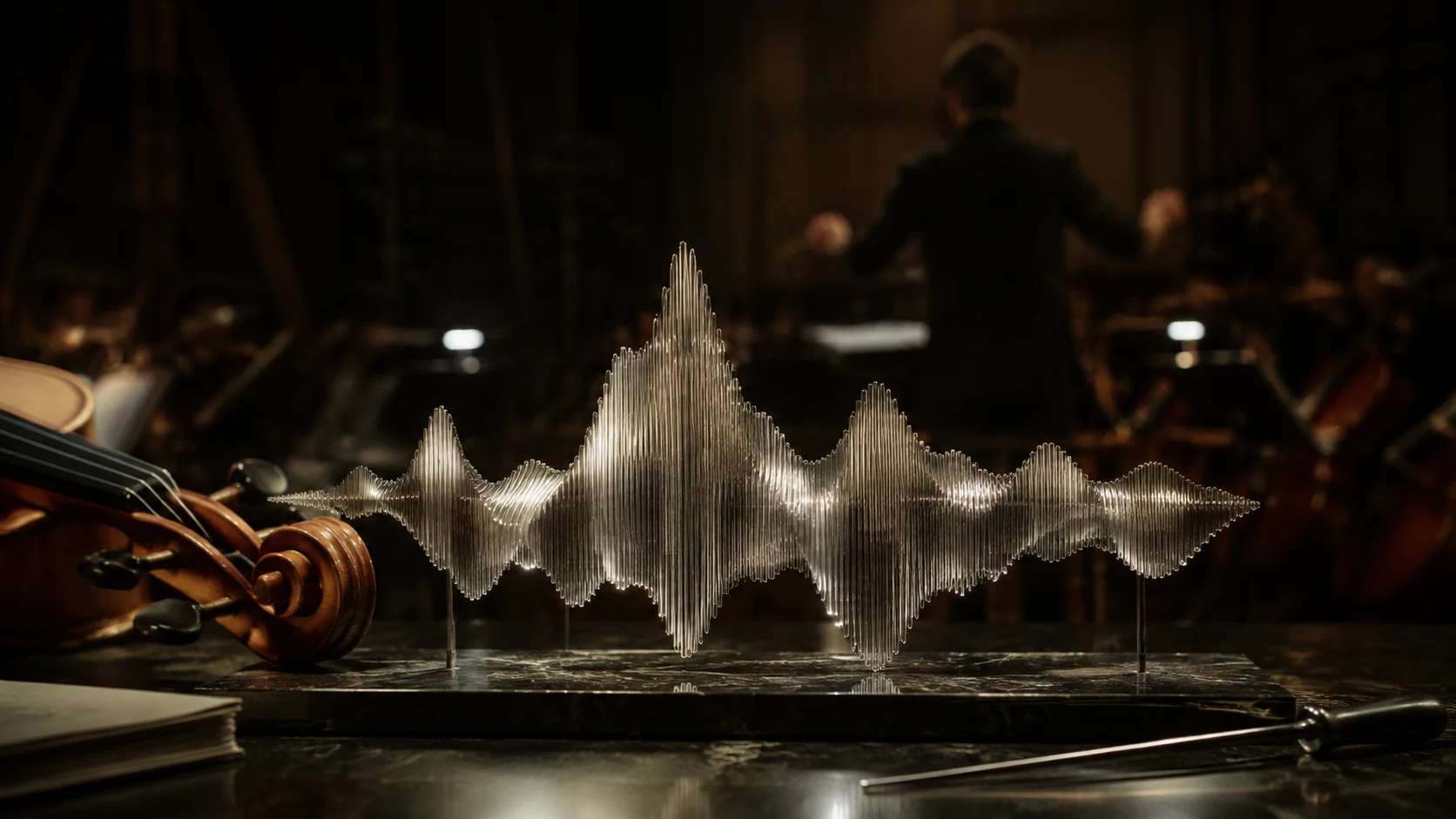
1. A symphony without a composer: the conductor of probability
We remember Mozart and Beethoven and speak of the anguish and joy in their music. For humans, composition was an intensely personal and spiritual act of pouring deep inner emotion onto a musical staff. Composition in the AI era operates through an entirely different mechanism. To recent generative-audio models such as Google’s MusicLM, Suno, and Udio, a score is not a record of emotion. It is a collection of patterns extracted from millions of audio tracks and the outcome of highly complex probability and statistics predicting the most appropriate next note at every moment.
In this process, the traditional status of the composer is dismantled and rebuilt. Humans are no longer artisans drawing and revising each note. They become prompt engineers and Conductors of Probability, coordinating and directing immense data flows. A single line—“melancholy jazz for a rainy day, ending on hopeful chords, with a 1980s lo-fi feel”—instantly becomes a completed symphony.
The definition of artistry changes here. Where artistry once depended on instrumental technique or knowledge of harmony, in the generative-audio era it shifts to Intent—the original direction given to AI—and Curation—which output to choose among countless results. AI can pour out infinite melodies, but selecting meaningful sounds that touch human hearts remains a human role.
2. Visualizing the invisible: eyes that see sound
One of generative AI’s most fascinating changes is the democratization of Synesthesia. Once only some artists sensed colors in sound or rhythm in shapes; now anyone can experience sensory transfer through technology. Cross-modal Generation, in which text becomes an image and the image becomes music, is dissolving artistic genre boundaries.
Consider Image-to-Audio. Feed in a Kandinsky abstract painting and AI analyzes the intensity of its colors and rhythm of its brushstrokes, transforming them into a grand orchestra. Provide a deep-ocean photograph and it generates quiet, weighty ambient sound. This is not a simple one-dimensional conversion. It is sophisticated intellectual play that Translates the essential Structure and Mood of visual data into an auditory language.
We now live in an era when we can hear Van Gogh’s The Starry Night and see Beethoven’s Moonlight Sonata. Beyond a curious experience, technology extends the biological limits of human senses. AI dismantles the solid barriers between senses and invites us into a world of infinite Resonance. Might this be the true aesthetic liberation the digital age offers?
3. The infinite jukebox: a universe of personalized sound
Generative audio has the potential to fundamentally change music consumption. Until now, we listened to fixed Recorded Music completed and released by artists. Future music, however, will become a stream generated in real time rather than a fixed result.
Imagine AI generating music in real time to match your heart rate, the weather, your walking speed, and your present mood. This music is unique in the world, existing and disappearing only for you at this moment. It is an Infinite Jukebox: organic music with no fixed beginning or end, endlessly varying and evolving with the listener’s circumstances.
This changes music from an object of appreciation into an environment of experience. Brian Eno’s concept of ambient music becomes fully realized through AI. Music is no longer fixed like a painting on canvas; it continually changes like flowing water and permeates daily life.
4. The immortality of voice: digital echoes and ethics
AI voice technology makes us question not only art but the boundary between life and death. The AI-restored voice of a deceased legendary singer performing a new song is no longer unfamiliar. The Beatles’ final new song and the voice of Kim Kwang-seok were such cases. Is this a moving tribute that lets us hear a missed voice again, or eerie digital necromancy commercially consuming the deceased regardless of their wishes?
The Digital Echo demonstrates that data can last forever even when the body disappears. An AI agent that perfectly learns my vocal tone, subtle tremors of breath, and characteristic expressions could read books or offer comfort to loved ones on my behalf after death. Sound is no longer a momentary vibration of air, but a digital inheritance that can be permanently preserved and reproduced.
Before this immortal sound, we reflect deeply on the singularity of human existence and the permanence of data. Technology offers a form of eternal life, but the philosophical debate over whether it is the true Self or an elaborate shell imitating me has only begun.
“Sound no longer remains merely a vibration of air. It is the Mathematical Sublime shaped by zeros and ones, and our most intimate conversation with machines. Beyond listening, we now compute sound and think alongside it.”