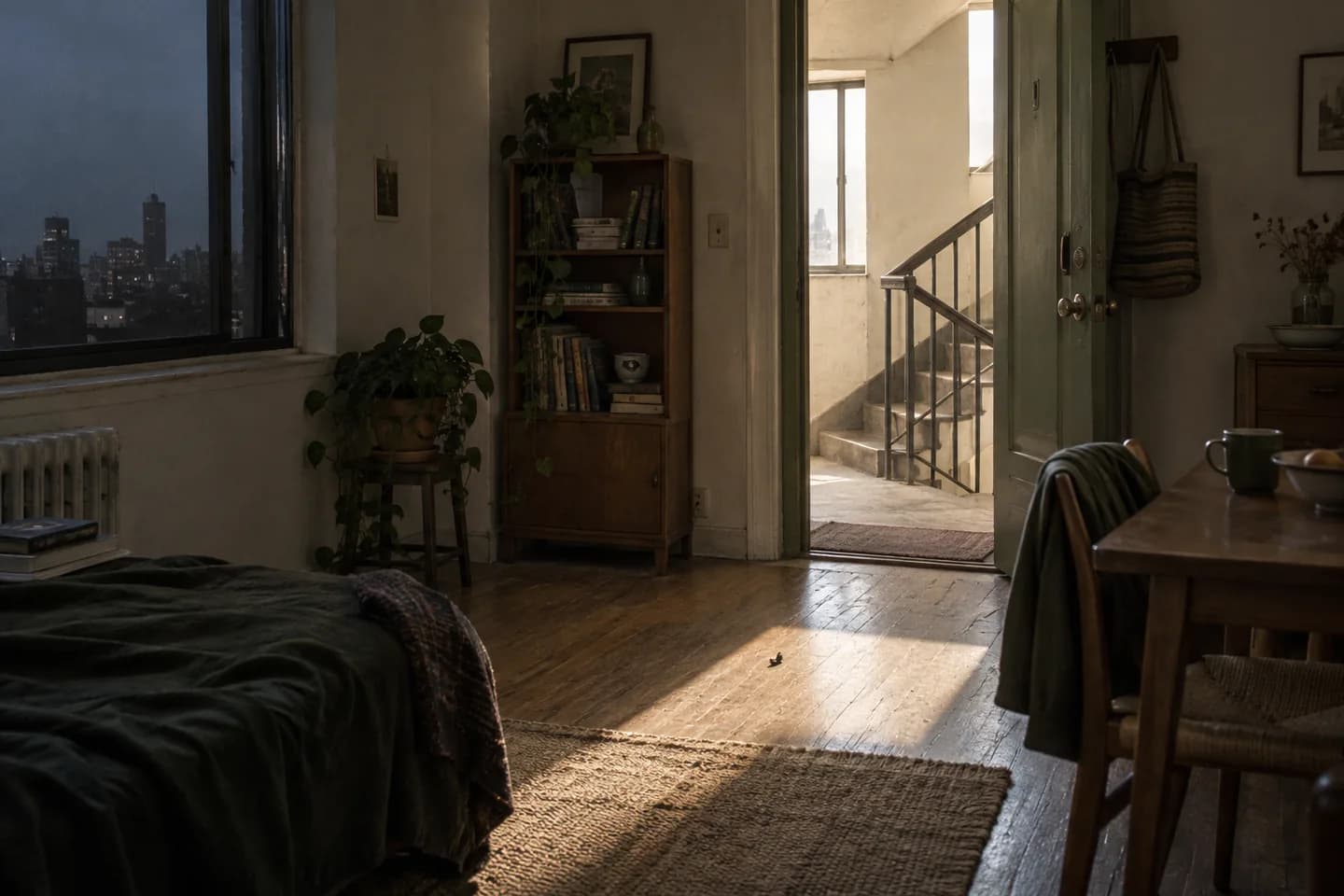
The Afternoon Seven Floors Down
Minseo stopped loosening the screws in the seventh-floor window and looked at the back of her hand. One screw had rolled off the sill into a bright square on the floor. The window itself was dark. The light had come from the stairwell at the end of the corridor.
“It went like that at noon,” the owner said, holding the curtain aside. “Fine this morning. Black by two.”
The service ticket had been filed at eleven forty. Perhaps the owner had got the time wrong. Perhaps the ticketing system had. Neither possibility explained the window. There was nothing wrong with its glass or frame; daylight simply wasn't arriving through the narrow conduit beneath the pane.
In the city's taller buildings, collectors on the roof sent light to windows on the floors below. Every window had a scheduled share. As the sun dropped, unused light went to the shared corridors. A resident could still open a window for air, but the building's allocation table determined when daylight reached it. In older blocks, the table often disagreed with the plumbing behind the walls.
 Generated fictional scene of the dark seventh-floor window and stairwell lightView original
Minseo read the little number beside the pane: 7-14. On her handheld, the afternoon slot for 7-14 was marked UNUSED. No electrical meter could tell her where the missing light had gone. She would have to follow the conduit.
The room below
Mr. Oh, the caretaker, wanted to take her up to the roof. Minseo asked to see the basement first. The conduit behind 7-14 passed an old laundry room on its way down.
“Nobody uses it,” he said.
“Is it locked?”
“The door opens.”
They took the stairs. A pair of wet trainers had been left outside a door on the third floor. On the ground floor, a new tenant's name was still taped to a mailbox on a slip of paper. The final flight was narrow enough that Minseo had to turn her toolbox in front of her. At the laundry-room door, Mr. Oh did not look for a key. He pushed it open.
There were no washing machines. A long table for laying out clothes stood against one wall, with three mismatched chairs, a sewing box and a folded dry towel. In a wall where there should not have been a window, there was one. Afternoon light fell from it onto one end of the table.
 Generated fictional scene of the lit basement worktableView original
Minseo put down her toolbox. A worn metal plate below the frame bore the number 7-14. The basement and the seventh floor shared a line. Someone had turned a diverter between them, or it had slipped. She could not tell which from the room alone.
“Who works here?”
“A few people. At night they use the office light. In the day they mend things here for a while.”
Mr. Oh moved a half-repaired sleeve across the table. A needle was still caught in the fabric; underneath it lay a small star folded from paper. Minseo left both where they were.
A room omitted from the list
The handheld divided the basement into a car park and a boiler room. The laundry appeared on an older plan, but not in the current allocation table. Minseo found no record of the window being removed, or of the room being sealed. A blank field seemed to have been copied from one revision to the next for years.
Mr. Oh brought down a folder. The old page carried a stamp registering this room as communal laundry. Behind it, a few ledger sheets said the machines had been taken away and the water pipes disconnected. The light conduit had remained. There was no page recording when people started using the room again.
“The resident upstairs has a reservation for this light,” Minseo said. “If I restore that window, this one goes dark.”
“I know.”
“Was it like this yesterday?”
“No. Until yesterday both got a little. I think the valve stuck to one side this morning.”
In the service cupboard she brushed dust from a small wheel on the diverter. It was turned halfway. There was a fresh scratch beside its rim. If the mechanism had failed, setting it back might have been an ordinary repair. If someone had moved it by hand, the reason mattered. Mr. Oh saw the scratch and said nothing.
The seventh-floor owner called again and asked for the repair to be finished that day. Minseo explained that light was going to a room absent from the current table. There was a pause. “What does that room have to do with my window?” the owner asked. The answer was embarrassingly short: they had one conduit between them. Explaining it did not make the conduit wider.
The inspection van
A municipal inspection van was due that afternoon. An older light line had leaked elsewhere in the block, and an inspector was coming to check open junctions. Minseo's ticket included a box marked SEAL UNREGISTERED BRANCH. The stamp in Mr. Oh's folder was old. The present system gave the basement room no address at all.
“Can we register the window?” he asked.
Minseo searched the menu. It would let her correct an existing address, not create one. She couldn't even open a request from this screen without choosing a registered room first.
The seventh-floor window belonged to a home that needed its afternoon share. The basement was being used as a workroom. Minseo had no authority to decide which claim deserved more light. She could record the diverter's position and measure both windows. She took out a meter and stepped around the table to keep the sleeve and paper star out of her photograph. The inspection concerned the line, not the things people had left here.
Mr. Oh rubbed the lower edge of the basement pane with his palm. A cloudy handprint appeared, then faded.
“No one uses this room in the morning,” he said. “And the seventh floor gets much more light than we do then.”
Minseo entered only the first statement. She could verify the room's hours, but she had not measured either window that morning. The caretaker was describing a morning she had not seen; the resident had called about the afternoon. Minseo kept the two accounts separate.
When she returned upstairs, the owner was waiting at the open door. Minseo explained that sealing the diverter now could restore the seventh-floor line and extinguish the basement window. Or she could submit the junction as found and ask the inspector to establish whether the basement had a valid address. Until then, she could promise neither window a reliable afternoon.
“What happens today?”
Minseo looked at the black pane. A pale square from the stairwell was reflected in it. “I'll leave the valve as it is. I'll report an unregistered window rather than close this as a broken one.”
The owner did not thank her. “And write down that my window isn't working.”
“I will.”
Minseo entered the two statements separately. One described the seventh-floor failure. The other described the basement window. Her handheld warned that she could not assign two addresses to the same line. She attached both photographs and a close view of the stamp on the old plan. The warning stayed on the screen.
What remained of the afternoon
As the inspection van drew up outside, someone came out of the basement with a length of cloth in one hand. A loose thread trailed from its edge. The person passed Minseo and Mr. Oh on the way to the mailboxes. Nobody asked who it was. Mr. Oh did not call out a name.
The inspector had not yet stepped out of the van. Minseo opened the ticket again to make sure the attachments had uploaded. The first showed the dark pane on the seventh floor; the second, a bright patch on a basement wall. Neither showed a person using the room.
She kept the handheld in her hand instead of putting it away. When the inspector came inside, she would show him both floors. She would explain that she had come to fix an upstairs window and found a room missing from the address list. Whether the inspector registered it or sealed the branch was not hers to decide.
There was still afternoon at the foot of the basement stairs. Upstairs, the owner had left her door open.